Nonprofit Event Planning: A Realistic Guide for Organizations That Can't Afford to Waste Money
Here's the uncomfortable truth about nonprofit event planning: most events lose money.
Not on paper—the final report shows revenue exceeding expenses. But factor in the staff time, the volunteer burnout, the opportunity cost of months spent planning instead of doing actual mission work, and the math often doesn't hold up.
I've watched nonprofits pour six months of effort into galas that netted $15,000. I've seen organizations spend $50,000 to raise $60,000 and call it a success. I've sat in post-event meetings where everyone celebrated while I did the mental math and stayed quiet.
Event planning for nonprofits is not the same as corporate event planning with a smaller budget. The constraints are different. The stakeholders are different. The definition of success should be different—but often isn't, because nonprofits import corporate event thinking without questioning whether it fits.
This guide is for nonprofit leaders, development directors, and board members who are tired of events that feel successful but don't actually move the mission forward. It's honest about what works, what doesn't, and what questions you should be asking before committing to another rubber chicken dinner.
If you're looking for "50 Creative Fundraising Ideas!" this isn't it. If you want someone to validate that your annual gala is worth the effort, you might not like what I have to say.
But if you want to plan nonprofit events that genuinely serve your mission—that raise real money, build real relationships, and don't burn out your team in the process—keep reading.
I've spent 25 years planning events across corporate and nonprofit sectors. The patterns are clear. Let me show you what I've learned.
Why Nonprofit Events Are Fundamentally Different

Stop planning nonprofit events like they're corporate events with less money. They're a different species entirely.
The budget math is backwards. Corporate events are expenses—investments in employee engagement, client relationships, or brand building. The ROI is indirect. Nonprofit events often need to generate money, not spend it. Every dollar on centerpieces is a dollar not going to the mission. That pressure changes everything.
Your "attendees" have multiple roles. At a corporate retreat, people show up as employees. At a nonprofit event, the same person might be a donor, a volunteer, a board member's spouse, and a potential major gift prospect. You're managing overlapping relationships and expectations simultaneously.
Volunteers are doing the work. Corporate events use paid vendors and staff. Nonprofit events rely heavily on volunteers who mean well but may lack experience, can't be managed like employees, and might not show up. Planning around volunteer capacity is a skill corporate planners never develop.
Emotions run high—in both directions. People at nonprofit events care about the cause. That passion is an asset when it generates generosity. It's a liability when the volunteer committee chair has opinions about the silent auction that conflict with what actually works.
The stakes feel existential. A mediocre corporate event is forgettable. A failed nonprofit event can damage donor relationships, exhaust your team, and set your fundraising back a year. The pressure is different when the mission depends on getting it right.
Your timeline is probably unrealistic. Corporate events get resourced appropriately. Nonprofit events get squeezed into already-overwhelmed schedules with the assumption that passion will compensate for inadequate planning time. It won't.
Understanding these differences is the first step toward planning events that actually work for your organization—not events borrowed from a context that doesn't apply.
Before You Plan Anything, Answer This Question
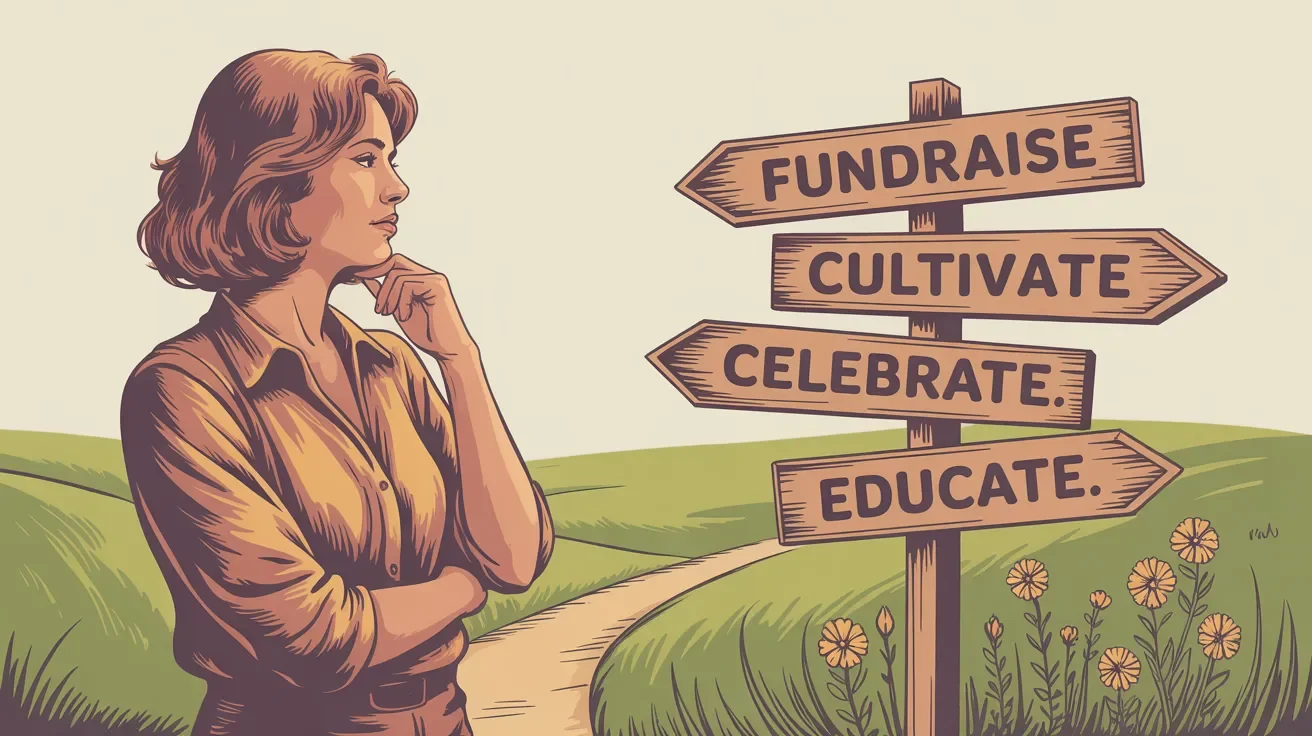
What is this event actually for?
Not "fundraising" or "community building" or "awareness." Those are categories, not purposes. I mean: what specific outcome justifies the investment of time, money, and energy this event will require?
Most nonprofit events fail because they're trying to do too many things. The gala is supposed to raise money and thank donors and attract new supporters and celebrate the year's accomplishments and give board members a chance to feel involved. That's five events crammed into one, and none of them will be done well.
Pick a primary purpose. Everything else is secondary.
If the purpose is fundraising, then every decision filters through "will this raise more money?" Expensive centerpieces? Only if they drive higher auction bids. Emotional mission moment? Yes, because it opens wallets. Long cocktail hour? Maybe, if it loosens people up before the ask.
If the purpose is donor cultivation, you're building relationships for future giving, not maximizing tonight's revenue. Different guest list, different format, different success metrics.
If the purpose is community celebration, you're thanking people and reinforcing their connection to the mission. Trying to squeeze fundraising into this confuses the message and cheapens the gratitude.
If the purpose is awareness, you're reaching new audiences. That might mean a public event, media involvement, or formats that prioritize accessibility over exclusivity.
Write your purpose in one sentence. Share it with everyone involved in planning. When disagreements arise—and they will—return to that sentence. Does this decision serve the purpose or not?
Our corporate retreat planning checklist starts with the same principle: objectives before logistics. It applies even more forcefully when resources are scarce.
The Events Most Nonprofits Should Stop Doing

I'm going to say what your tired development director is thinking but won't say out loud: some of your events aren't worth doing.
The annual gala that nets less than a direct mail campaign. If your gala costs $75,000 to produce and raises $100,000, your net is $25,000. A well-executed direct mail or email campaign might net more with a fraction of the effort. But the gala is tradition, so nobody questions it.
The golf outing that exists because a board member likes golf. Not every organization's donor base plays golf. Not every community has golf culture. If your tournament attracts the same 80 people every year and hasn't grown in a decade, it's a habit, not a strategy.
The awareness event that doesn't convert to donors. Lots of people showed up. Great press coverage. Wonderful energy. And then... nothing. If awareness doesn't eventually translate to supporters, money, or mission impact, you've hosted a party, not advanced your cause.
The small events that fragment your capacity. Multiple small events spread throughout the year can drain more resources than one major event. Each one requires planning, promotion, volunteer coordination, and staff time. Death by a thousand cuts.
The inherited event nobody remembers starting. "We've always done the spring luncheon." Why? Who decided? Does it still make sense? The fact that something has happened for 15 years doesn't mean it should happen for 16.
I'm not saying cancel everything. I'm saying evaluate honestly. What would happen if you didn't do this event? Would donors notice? Would revenue actually decline, or would the money come in through other channels?
Sometimes the bravest thing a nonprofit can do is stop.
What Actually Works for Nonprofit Fundraising Events
Now that I've told you what to stop doing, here's what actually moves the needle.
Smaller, more personal events raise more per person. A dinner for 30 major donor prospects in someone's home will often generate more revenue than a gala for 300. Intimacy creates connection. Connection creates generosity. You don't need to impress people with production value; you need to move them.
Mission visibility matters more than décor. Donors give to impact, not to tablecloths. The event that shows your work in action—a site visit, a program demonstration, a direct conversation with someone you've helped—creates emotional resonance that no amount of professional lighting can match.
The ask needs to be clear and specific. Vague appeals for "support" generate vague responses. "Tonight we're raising $50,000 to send 25 kids to summer camp" is concrete, achievable, and urgent. People respond to specificity.
Peer-to-peer pressure works. When a respected community member publicly commits to giving, others follow. Board members who give first, give visibly, and ask their peers directly are more effective than any professional auctioneer.
Follow-up is where money actually gets raised. The event is the beginning of the conversation, not the end. Systematic follow-up with everyone who attended—thank yous within 48 hours, personal calls to prospects, cultivation of new connections—converts event energy into actual dollars. Most nonprofits fumble this completely.
Lower costs increase net revenue. Every dollar you don't spend on venue, catering, and production is a dollar that goes to the mission. Donors respect fiscal responsibility. The best nonprofit events feel authentic and mission-focused, not like you're trying to compete with corporate galas.
Our guide to charity event planning goes deeper on fundraiser-specific tactics—budgeting, sponsorship, and making sure you actually net money.
Building Your Event Around Budget Reality

Start with your net goal, then work backwards.
If you need to net $50,000, and you're planning to spend $30,000 on the event, you need to gross $80,000 just to hit your target. Is that realistic for your donor base? If not, either reduce expenses or adjust expectations—don't just hope for the best.
Track the full cost, not just the obvious expenses. Staff time has value. If your development director spends 200 hours on gala planning at an effective hourly rate of $40, that's $8,000 in hidden costs. Volunteer time has opportunity cost too—those volunteers could be doing other things for your organization.
Question every line item. Do you need printed programs, or would a simple card suffice? Does the venue require that caterer, or can you negotiate? Are fresh flowers essential, or would your volunteers' garden cuttings create more authentic charm? Every expense should earn its place.
Sponsorships are not free money. They come with deliverables, recognition requirements, and relationship management. A $10,000 sponsorship that requires $3,000 in benefits and 20 hours of staff time isn't really $10,000. Calculate the true net.
In-kind donations reduce costs but not effort. Donated auction items still need to be solicited, tracked, displayed, and delivered. Donated services still require coordination. The hidden cost is staff and volunteer time. Factor it in.
Build a contingency. Something will cost more than expected. RSVPs will fall short of projections. The weather will threaten your outdoor backup plan. If your budget has no margin, you have no room to adapt.
Know your break-even number. At what attendance level, ticket price, or donation total do you stop losing money? Make sure that number is realistic given your organization's history and reach.
Staffing and Volunteers—The Nonprofit Difference

The staffing model that works for corporate events doesn't exist in nonprofits. You're working with a hybrid of limited paid staff, well-meaning volunteers, and board members who want to help but may not know how.
Be realistic about staff capacity. If your development team is two people, they cannot plan a 300-person gala while also managing individual giving, grant applications, and donor communications. Something will suffer. Usually everything suffers a little, which is worse than doing fewer things well.
Volunteers are not free labor. They require recruitment, training, management, appreciation, and patience. A volunteer who doesn't show up, shows up unprepared, or does the job wrong can create more work than they save. Build in redundancy and never put a critical task in untested hands.
Match tasks to skills and interests. The volunteer who loves spreadsheets should not be greeting guests. The extrovert who lights up a room should not be stuffing envelopes alone in the back. Mismatched assignments frustrate volunteers and produce poor results.
Board members need clear roles. "Help with the event" is not a role. Selling tables, making thank-you calls, greeting VIP donors, bidding on auction items to drive prices up—these are roles. Undefined involvement leads to board members either doing nothing or doing the wrong things.
Create foolproof systems. Written instructions. Checklists. Backup contacts. The assumption that someone "knows what to do" is how things fall through cracks. Especially with volunteers who may have helped last year but don't remember the details.
Appreciate publicly and specifically. Volunteers who feel genuinely valued come back. Generic "thanks to our wonderful volunteers" doesn't cut it. Name names. Note specific contributions. Make people feel seen.
Consider whether professional support makes sense. Our post on when to hire a nonprofit event planner covers the decision honestly—including when it's not worth the cost.
Promotion That Doesn't Require a Marketing Budget

You probably don't have a marketing budget. That's fine. The most effective nonprofit event promotion doesn't require one.
Personal outreach beats mass communication. A direct email from a board member to someone they know personally has a higher response rate than any beautifully designed invitation. Your best promotional asset is your people and their networks. Use them.
Board members should be selling, not just attending. Every board member should have a specific goal—sell two tables, recruit five attendees, secure one sponsor. Public accountability helps. "The board has collectively committed to filling 40 seats" creates peer pressure that vague expectations don't.
Email remains the workhorse. Social media is noisy and algorithmic. Email lands directly in inboxes. Multiple touches over time—save the date, formal invitation, reminder, last chance—build awareness and urgency without requiring ad spend.
Make sharing easy. Give supporters pre-written messages they can forward, social posts they can share, and clear instructions for how to spread the word. People want to help but won't invest effort figuring out how.
Local media might care. Community newspapers, local TV, neighborhood blogs—they need content, and your event might be interesting to them. A well-crafted press release and personal outreach to reporters costs nothing but time.
Partner with aligned organizations. Other nonprofits, local businesses, community groups—who shares your audience and might promote your event in exchange for recognition or reciprocal promotion?
Create urgency authentically. Early bird pricing. Limited attendance. Matching gift deadlines. Urgency drives action, but manufactured urgency feels manipulative. Find the real deadlines and communicate them.
Start earlier than you think. Nonprofit events compete with every other demand on your supporters' calendars. Sixty to ninety days of promotion is not too much for a major event. Save the dates should go out even earlier.
The Day-Of Details That Make or Break It

You've planned for months. Now it's the day of the event, and execution determines whether that planning pays off.
Have one person in charge. Not a committee. One person with authority to make decisions, solve problems, and direct volunteers. Everyone should know who that person is. Confusion about leadership creates chaos.
Brief your team thoroughly. Every volunteer and staff member should know what they're doing, when, and who to ask if something goes wrong. A 15-minute briefing before guests arrive prevents hours of confusion during the event.
Build a minute-by-minute timeline. When does setup start? When do volunteers arrive? When do doors open? When does the program begin? When does each element happen? Written timelines keep everyone synchronized.
Assign someone to handle problems. Not the event lead—they need to stay focused on the big picture. A designated troubleshooter handles the vendor who's running late, the guest who can't find their table, the AV glitch that needs immediate attention.
Have contingency plans. What if it rains? What if the speaker cancels? What if attendance is higher or lower than expected? You won't anticipate everything, but thinking through likely scenarios helps you respond faster.
Protect the donor experience. VIP donors should feel special. Major gift prospects should be personally welcomed. Board members should know which guests to prioritize for conversation. Don't leave relationship-building to chance.
Someone should be documenting. Photos, videos, attendee quotes—you need content for thank-yous, next year's promotion, and grant reports. Assign this specifically; it won't happen organically.
Our corporate retreat planning checklist has a logistics section that translates well to nonprofit events—the principles of day-of execution don't change based on sector.
After the Event—Where Most Nonprofits Drop the Ball

The event ends. Everyone exhales. And then... nothing happens for two weeks.
This is where most nonprofits squander the goodwill and momentum they just spent months building.
Thank-yous should go out within 48 hours. Not the tax receipt—a genuine thank you. Personal notes to major donors. Segmented emails to attendees. Board members calling the guests they invited. Speed matters because recency matters. A thank you that arrives two weeks later feels like an afterthought.
Follow up with every prospect identified. The new attendee who seemed interested. The guest who asked questions about your programs. The person who gave for the first time. These are warm leads. Treat them accordingly.
Debrief while memory is fresh. What worked? What didn't? What would you do differently? Gather input from staff, volunteers, and board members within a week. Document it for next year. The insights you'll remember in twelve months are the ones you write down now.
Calculate real results. Not just gross revenue—net revenue after all expenses including staff time. Attendance versus goal. New donors acquired. Existing donors retained. Sponsors renewed. Be honest about what the event actually produced.
Connect event outcomes to mission impact. Donors gave money to advance your cause, not to fund a party. Tell them what their generosity enabled. "Because of your support at last month's gala, 50 families now have..." completes the circle.
Decide if you'll do it again. Based on actual results, not tradition or obligation. Does this event deserve your resources next year? Should it change? Should it grow or shrink? Make a deliberate decision rather than defaulting to repetition.
The event isn't over until the follow-up is complete. Budget time for this phase just like you budget time for planning and execution.
Nonprofit event planning is harder than corporate event planning—not because the events are bigger, but because the margin for error is smaller and the resources are thinner.
The organizations that get it right plan with clear purpose, budget realistically, staff appropriately, and follow through completely. They're also willing to question whether an event is worth doing at all.
Purple Wave Creative helps nonprofits and associations plan events that actually serve the mission—without burning out staff or disappointing donors. Contact us if you want experienced guidance for your next event.